The 10 Greatest Mathematicians of All Time

Mathematics is unique among human intellectual achievements: it is universal in scope, eternally rigorous in logic, and foundational to the sciences, engineering, and finance. From the earliest recorded civilizations to the modern era of computers and abstraction, certain individuals have reshaped the subject so profoundly that their ideas continue to define what it means to do mathematics.
In this story of ingenuity and insight, we celebrate the ten greatest mathematicians of all time — figures whose work has transformed our understanding of patterns, space, numbers, and structures. Each entry combines biography, major achievements, and the lasting influence of these extraordinary thinkers.
Our list is ordered by birthdate, beginning with the youngest of these giants and moving back through history, illustrating how successive generations built upon the ideas of their predecessors.
1) Archimedes (c. 287–212 BC)

Archimedes of Syracuse is often considered the greatest mathematician of ancient times and one of the most brilliant minds ever recorded. His legacy bridges pure mathematics and physical application in a way that would not be matched for centuries.
Unlike many of his contemporaries, Archimedes applied rigorous reasoning to problems of geometry and also anticipated ideas later formalized as calculus. He developed methods to compute areas and volumes — such as the area of a circle, the surface area and volume of a sphere, and the volume under a parabola — using what we now recognize as the method of exhaustion and early infinitesimal reasoning.
Beyond pure math, Archimedes applied his insights to mechanics. He articulated the laws of levers, centers of gravity, and buoyancy (commonly known as Archimedes’ Principle), and designed ingenious machines, including the screw pump that still bears his name. His work represents a synthesis of analytic rigor and practical invention, making him a foundational figure in both mathematical thought and engineering.
2) Isaac Newton (1643–1727)

Isaac Newton is best known for his work in physics, but his contributions to mathematics are equally monumental. Alongside Gottfried Wilhelm Leibniz, he independently developed calculus, laying the quantitative groundwork for motion, change, and physical law. This systematization of the physical world allowed for the development of engineering and the concomitant rise of the Industrial Revolution.
Newton’s method of fluxions provided a way to analyze instantaneous rates and accumulated change — ideas essential to modern science. His work in infinite series, binomial expansions, and root approximations further shaped the analytical tools mathematicians use today.
More than a collection of techniques, Newton’s approach unified algebraic manipulation with geometric intuition and physical insight, helping make calculus a bridge between mathematics and the physical sciences.
3) Gottfried Wilhelm Leibniz (1646–1716)

A contemporary of Newton, Leibniz deserves equal credit for the invention of calculus — and, in many ways, for making calculus usable. While Newton’s notation was grounded in his own geometric conception of time and motion, Leibniz introduced the symbols most familiar to students today: the integral sign ∫ and the differential dx.
Leibniz’s ideas extended far beyond notation. He contributed to early matrix theory, determinants, and the beginnings of what would become Boolean logic. His philosophical commitment to rationality and analysis also influenced the formal foundations of mathematics.
Leibniz’s legacy is both technical and conceptual: he not only discovered key methods, but also endowed them with the clarity that would enable later generations to expand mathematics into the modern era.
4) Leonhard Euler (1707–1783)

Leonhard Euler is frequently counted among the most influential mathematicians of all time — and arguably the most prolific. His work spans calculus, number theory, graph theory, topology, and complex analysis. So numerous are Euler’s contributions that entire branches of mathematics contain his name: Euler characteristic, Euler’s formula in complex analysis, Euler’s totient function in number theory, and countless identities involving e, π, and i.
Euler also played a pivotal role in shaping the notation of modern mathematics. He popularized function notation f(x), introduced e as the base of natural logarithms, normalized π as a constant symbol, and helped standardize i for the imaginary unit.
His mastery was not confined to abstract thought: Euler’s work on series, differential equations, and mechanics had immediate application in physics and engineering, as well as in pure mathematics. Few mathematicians have left such a broad, deep, and enduring imprint on the field.
5) Joseph-Louis Lagrange (1736–1813)

Born in Italy and later working in Paris, Joseph-Louis Lagrange was a master of analysis whose influence shaped the direction of mathematics in the late 18th and early 19th centuries. Lagrange’s analytical approach to mechanics — especially his Mécanique analytique — recast classical mechanics in purely mathematical terms without reliance on geometry.
In mathematics, he developed foundational work on differential equations, the calculus of variations, group theory, and number theory. His proof of Wilson’s Theorem and his celebrated Four Squares Theorem are landmarks in algebra and number theory.
Lagrange’s insistence on analysis over synthetic methods helped usher mathematics toward greater abstraction and generality, setting the stage for 19th-century advances.
6) Carl Friedrich Gauss (1777–1855)

Carl Friedrich Gauss is widely regarded as the Prince of Mathematics and one of the greatest theorem provers in history. His Disquisitiones Arithmeticae established number theory as a systematic discipline and remains a cornerstone of the field.
Gauss’s contributions span number theory, algebra, statistics, geometry, and analysis. Among his major achievements are rigorous proofs of the Fundamental Theorem of Algebra, the law of quadratic reciprocity, and the construction of the regular 17-gon using ruler and compass. His work laid the foundations for modern differential geometry, which later became essential to Einstein’s theory of general relativity.
He also applied mathematics to astronomy and geodesy, solving practical problems such as predicting the orbit of the asteroid Ceres. Gauss’s breadth — deep theoretical insight matched with practical application — is a hallmark of his lasting influence.
7) Bernhard Riemann (1826–1866)

Bernhard Riemann’s work represents a paradigm shift in how mathematicians conceive space and structure. His Riemannian geometry extended geometry beyond Euclid’s postulates, introducing the idea that geometry could vary with curvature — a concept that would later underpin Einstein’s theory of general relativity.
Riemann also revolutionized analysis with the notion of what we now call the Riemann integral, and linked disparate areas of mathematics by applying topology to number theory. His famous Riemann Hypothesis, concerning the zeros of the zeta function, remains one of mathematics’ most profound unsolved problems.
Though his life was tragically short, Riemann’s vision reshaped modern mathematics, influencing fields from complex analysis to theoretical physics.
8) Henri Poincaré (1854–1912)

Henri Poincaré was one of the last polymaths, contributing to mathematics, physics, and the philosophy of science. His work in topology, particularly the foundational ideas leading to the formulation of the Poincaré Conjecture, helped launch algebraic topology as a major field of mathematics.
Poincaré was also a pioneer in the study of dynamical systems and celestial mechanics, anticipating chaos theory by recognizing the sensitivity of systems to initial conditions. His approach blended deep geometric insight with analytical rigor and physical intuition.
Poincaré’s breadth — from foundational questions in geometry to practical problems in physics — highlights his role as a bridge between pure and applied mathematics.
9) David Hilbert (1862–1943)

David Hilbert was a transformative figure in the early 20th century, best known for his work on the foundations of mathematics and for formalizing the axiomatic approach to geometry. He identified and articulated 23 fundamental problems — the Hilbert Problems — that guided mathematical research for generations.
Hilbert made substantial contributions to functional analysis, invariant theory, number theory, and mathematical physics. His work shaped the development of modern algebra and analysis, and his influence extended into logic and computer science.
Perhaps most importantly, Hilbert’s belief in the completeness and coherence of mathematics inspired research into formal systems, laying groundwork for later advances in logic and computation.
10) John von Neumann (1903–1957)
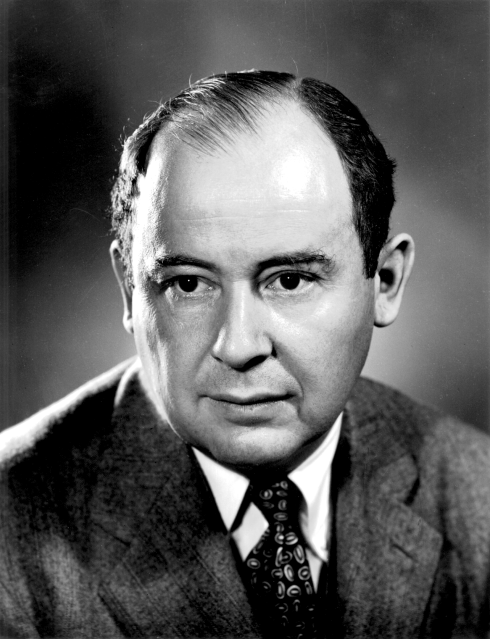
John von Neumann was a prodigy whose range of contributions spanned pure mathematics, quantum theory, computing, economics, and beyond. In mathematics, he helped formalize operator theory, foundational for quantum mechanics; contributed to set theory and game theory; and pioneered ideas in numerical analysis.
Von Neumann’s work on the mathematical theory of self-replicating automata, cellular automata, and the design of modern computers marked him as a pioneer in what would become computer science. His mathematical formalization of quantum mechanics — now known as von Neumann algebras — provides the rigorous underpinning for much of quantum physics.
Von Neumann exemplifies the modern mathematician whose work bridges abstract theory and transformative technology. Among these many accomplishments he is also credited with perhaps the greatest popular quote among modern mathematicians — "If people do not believe that mathematics is simple, it is only because they do not realize how complicated life is."
Why These Mathematicians Matter
What connects these ten great mathematicians is not only breadth of achievement but also depth of influence. Each reshaped fundamental ideas about quantity, space, structure, or computation:
Archimedes and Gauss expanded the reach of geometry and number theory.
Newton and Leibniz gave the world calculus — a language for change.
Euler and Riemann wove together analysis, algebra, and topology.
Lagrange and Poincaré pushed mathematics toward abstraction and dynamical insight.
Von Neumann and Hilbert anchored it in formal systems that power modern logic and computing.
Across time, their ideas have become the bedrock upon which contemporary science and technology are built. From space exploration to encryption algorithms, calculus to quantum mechanics, the legacy of these mathematicians continues to powerfully shape our world.