
Beyond the Big Three: A Guide to the Lesser-Known Ivy League Universities

When discussing Ivy League universities, a handful of institutions often dominate the conversation. Harvard, Yale, and Princeton, sometimes referred to as the “Big Three,” are widely recognized for their long histories, global reputations, and highly selective admissions processes. These universities consistently attract large numbers of top-tier applicants and maintain high enrollment yields, reinforcing their status as some of the most prestigious institutions in the world. For many students and families, admission to one of these schools is often seen as a “golden ticket” to future academic and career success.
However, focusing solely on these well-known names can overlook the broader picture. The Ivy League is made up of eight distinct universities, all offering exceptional academic opportunities, accomplished faculty, and strong career outcomes. While Harvard, Yale, and Princeton receive the most attention, educational quality across the Ivies is consistently high, and long-term success is often shaped more by how students engage with opportunities than by the institution they attend.
This article explores the five Ivy League universities that are frequently out of the spotlight: Dartmouth College, Brown University, Columbia University, Cornell University, and the University of Pennsylvania. Each offer a distinct approach to undergraduate education, and understanding these differences can help students make more thoughtful, informed application decisions.
Exploring the lesser-known Ivy League universities
From flexible curricula and close-knit student communities to unique research opportunities and career-focused pathways, the Ivy League offers diverse academic environments. Here we take a closer look at some lesser-known Ivies and what makes each one distinct.
Dartmouth College, Hanover, NH

As the smallest Ivy League institution, Dartmouth College is recognized for its close-knit academic environment and strong focus on undergraduate education. With a 6:1 student-to-faculty ratio and small class sizes, Dartmouth encourages discussion-based learning, mentorship opportunities, and strong academic relationships between students and faculty.
One of Dartmouth’s most distinctive features is the flexible academic calendar, known as the D-Plan. This quarter-based system allows students to customize their schedules, making it easier to pursue internships, research opportunities, or study abroad experiences throughout the year. For students interested in combining academic study with real-world experience, this flexibility is a significant advantage.
The campus at Dartmouth is surrounded by scenic, natural landscapes shaping a student experience closely connected to the outdoors. Initiatives such as the First-Year Trips program, which introduces students to activities like hiking, kayaking, and farming, while additional opportunities like the Dartmouth Skiway offer a unique student experience.
Dartmouth College at a glance:
Acceptance rate | Average SAT | Average ACT | Popular majors | Undergrad. population | Notable alumni |
5% - 6% | 1500 to 1570 | 33 - 35 | Economics, Government, Computer Science, Engineering, Biology/Psychology | ~4,500 | Mindy Kaling, Robert Frost, Dr. Seuss, Nelson Rockefeller
|
Dartmouth College is particularly well suited to students who:
• Prefer small, close-knit academic communities
• Value strong undergraduate teaching and mentorship
• Enjoy outdoor lifestyles and a traditional campus setting
• Want flexibility in structuring internships and study periods
Columbia University, New York, NY
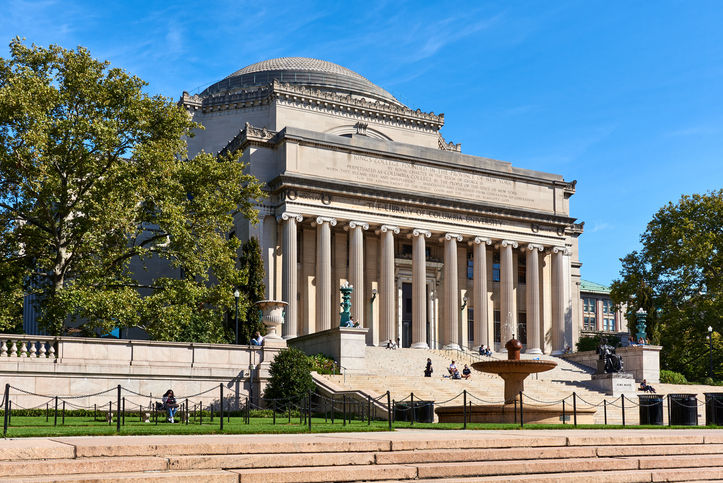
Located in the Morningside Heights area, Columbia’s enclosed campus provides a classic collegiate setting. At the same time, its location in New York City offers unparalleled access to cultural institutions, internships, and professional opportunities across fields such as media, finance, international relations, and the arts.
A defining feature of Columbia’s undergraduate experience is its rigorous Core Curriculum. All students complete a series of small, discussion-based seminars in literature, philosophy, history, science, and contemporary civilization, creating a shared intellectual foundation regardless of major. This interdisciplinary approach encourages critical thinking and broad academic exploration, making Columbia particularly appealing to students who value structured learning alongside academic flexibility.
As one of the most internationally diverse Ivy League universities, Columbia attracts students from around the world and serves as a hub for global research and collaboration. The university also administers the prestigious Pulitzer Prize, reinforcing its long-standing influence in journalism, literature, and public affairs.
Columbia University at a glance:
Acceptance rate | Average SAT | Average ACT | Popular majors | Undergrad. population | Notable alumni |
4% | 1470 to 1570 | 34 - 35 | Computer Science, Economics, Political Science, Psychology, History | ~9,000 | Barack Obama, Alexander Hamilton, Amelia Earhart, Jack Kerouac |
Columbia is ideal for students who:
• Thrive in fast-paced, urban environments
• Value a structured, discussion-based curriculum
• Seek strong access to internships and professional networks in New York City
• Appreciate global perspectives and diverse communities
Brown University, Providence, RI

Brown University offers one of the most distinctive academic experiences in the Ivy League, shaped by its renowned Open Curriculum. This approach removes traditional core course requirements, giving students the freedom to design their own academic path. Students are encouraged to pursue their interests, explore different disciplines, and build a degree around what genuinely motivates them. With access to more than 80 undergraduate concentrations, this allows movement between diverse fields as well as subject specialization.
Beyond academics, Brown is recognized for its creative and student-driven campus culture. With over 500 organizations, students can get involved in everything from debate and performing arts to entrepreneurship and community service. While athletics are not the central focus of campus life, Brown maintains competitive teams in sports such as rowing, soccer, and ice hockey, alongside a wide range of recreational opportunities.
The campus itself blends historic architecture with modern facilities, creating an environment that feels both traditional and forward thinking. Located in Providence, students benefit from a vibrant arts scene, diverse restaurants, and cultural events. This combination of academic flexibility, creative energy, and urban access gives Brown a distinctive identity.
Brown University at a glance:
Acceptance rate | Average SAT | Average ACT | Popular majors | Undergrad. population | Notable alumni |
5% - 5.5% | 1510 to 1580 | 34 - 35 | Computer Science, Economics, Biology, International Affairs, Applied Math | 7,000 – 8,000 | Janet Yellen, Emma Watson, John F. Kennedy Jr., Jhumpa Lahiri |
Brown is a strong choice for students who:
• Want maximum academic freedom and flexibility
• Prefer interdisciplinary learning and exploration
• Thrive in creative, collaborative environments
• Value a balanced academic and social experience
Cornell University, Ithaca, NY

Often referred to as “Big Red,” Cornell University is distinguished within the Ivy League by its size and wide-ranging academic offerings. Located in Ithaca, New York, the campus spans over 2,300 acres of rural landscape, including gorges, hills, and lakes, giving it a distinctly open and expansive feel compared to more compact Ivy League settings.
Cornell is unique among the Ivies for its college-based structure, where students apply directly to specialized schools such as engineering, business, agriculture, and hospitality. This approach makes it particularly well suited to students who already have a clear academic direction in mind. The university also has a long history of academic innovation, awarding the first journalism degree and establishing one of the earliest veterinary medicine programs in the US, reflecting its strong emphasis on applied learning and real-world impact.
As the largest Ivy League university, student life at Cornell is energetic and supported by more than 1,000 student organizations. Events like Slope Day, a large end-of-year campus celebration with music and performances, and Dragon Day, a long-running student tradition involving elaborate creative builds, reflect the university’s vibrant campus culture.
Cornell University at a glance:
Acceptance rate | Average SAT | Average ACT | Popular majors | Undergrad. population | Notable alumni |
8.4% | 1510 to 1560 | 33 - 35 | Computer Science, Engineering, Business & Finance, Biomedical Science, Social Science | ~16,000 | Toni Morrison, Bill Nye, Carl Sagan |
Cornell may appeal most to students who are:
• Seeking a large, research driven university experience
• Prefer structured, specialized academic pathways
• Interested in STEM or applied professional fields
• Enjoy a traditional, large-scale campus with a vibrant culture
University of Pennsylvania, Philadelphia, PA

Founded by Benjamin Franklin in 1740, the University of Pennsylvania (often referred to as Penn) combines Ivy League tradition with a strong emphasis on practical, career-focused education. Located in Philadelphia, Penn offers an urban campus experience where historic streets, cultural landmarks, and modern academic buildings sit side by side, giving students access to both city life and professional opportunities.
Academically, Penn is best known for the Wharton School of Business. Consistently ranked as one the top business schools in the world, Wharton offers world-class programs in finance, entrepreneurship, and management, attracting students who are focused on careers in business, consulting, and leadership. Alongside this, Penn offers unique interdisciplinary pathways, such as the Huntsman Program in International Studies and Business (combining language study, international studies, and business) and the Biological Basis of Behavior program (integrating biology, psychology, and neuroscience).
Penn’s distinctiveness lies in its combination of high-intensity academics, strong professional pathways, and direct access to opportunity in a major US city. Students are able to move fluidly between classroom learning and real-world engagement, with access to internships, cultural institutions, and professional networks throughout their degree.
Penn University at a glance:
Acceptance rate | Average SAT | Average ACT | Popular majors | Undergrad. population | Notable alumni |
8.41% | 1510 to 1560 | 34 - 35 | Business Studies Economics Life Sciences Social Sciences Computer Science | ~11,000 | Warren Buffet, Donald Trump, Elon Musk, Tory Burch,
|
Penn is a strong fit for students who are:
· Focused on business and pre-professional pathways
· Prefer an urban campus with access to internships and networking
· Are goal-oriented with clear career ambitions
· Enjoy a fast-paced academic and social environment
Wrapping up
When most students think about Ivy League universities, a small group of well-known names often comes to mind. However, as this article has shown, the Ivy League is far more varied than this initial impression suggests, with each institution offering a distinct academic structure, campus environment, and student experience.
For students, the most important factor is not reputation alone, but how well a university aligns with your preferred learning style, interests, and long-term goals. This requires careful research into each institution, reflection on what kind of college experience you are looking for, and, where possible, attending open houses or campus visits to better understand the environment. Speaking with current students or alumni can also provide insight that goes beyond official descriptions and global rankings.
Once you have identified the universities that best match your goals, it is worth strengthening your application through relevant academic enrichment. Summer courses, internships, and subject-focused programs can help demonstrate genuine interest in your chosen field and help your college application really stand out.


